
Fremont County Court Records After Arrest
A Fremont County jail arrest is the first public event in many criminal matters, but it is not the same record as a filed court case. The Fremont County Sheriff press-release page and local arrest logs can show the arrest date, agency, charge code, incident number, warrant number, release reason, and bond language. Those records show what law enforcement reported at booking or soon after the arrest. The court record starts when the charge moves into the Iowa court system through a complaint, information, indictment, citation, or warrant-related filing.
The court pathway in Fremont County usually runs from arrest and booking, to initial appearance, to prosecutor review, to clerk entry. The Fremont County Attorney prosecutes state-law and county-ordinance violations, and the District Court Clerk maintains the official case record once it is opened. The jail side is useful for custody and booking details, while the jail inmate records page is the better place for current custody routing. Booking photos and sheriff-published arrest images belong with jail roster mugshots, not with the court docket.
For court records after a jail arrest, the key point is that arrest charges can change. The prosecutor may file a different charge, amend the level, add counts, dismiss a count, or decline to file. A court disposition is the case outcome, not the booking accusation. The sheriff's incident number can help identify the event, but it is not always the court case ID.
Find Fremont County Court Records
Filed criminal cases are searched through Iowa Courts Online. Fremont County is in Iowa Judicial District 4, and the Iowa Judicial Branch Fremont County District Court page lists the Clerk of Court at PO Box 549, Sidney, IA 51652, phone 712-374-2232, fax 712-374-3330, and CountyClerk.Fremont@iowacourts.gov. Search the court portal first when the goal is filed charges, case status, docket entries, fines, fees, or disposition. Call the clerk for older cases, public-terminal access, or records that do not appear online but should be public.
The Iowa Courts Online portal is the official court search source for criminal docket records after a Fremont County arrest.
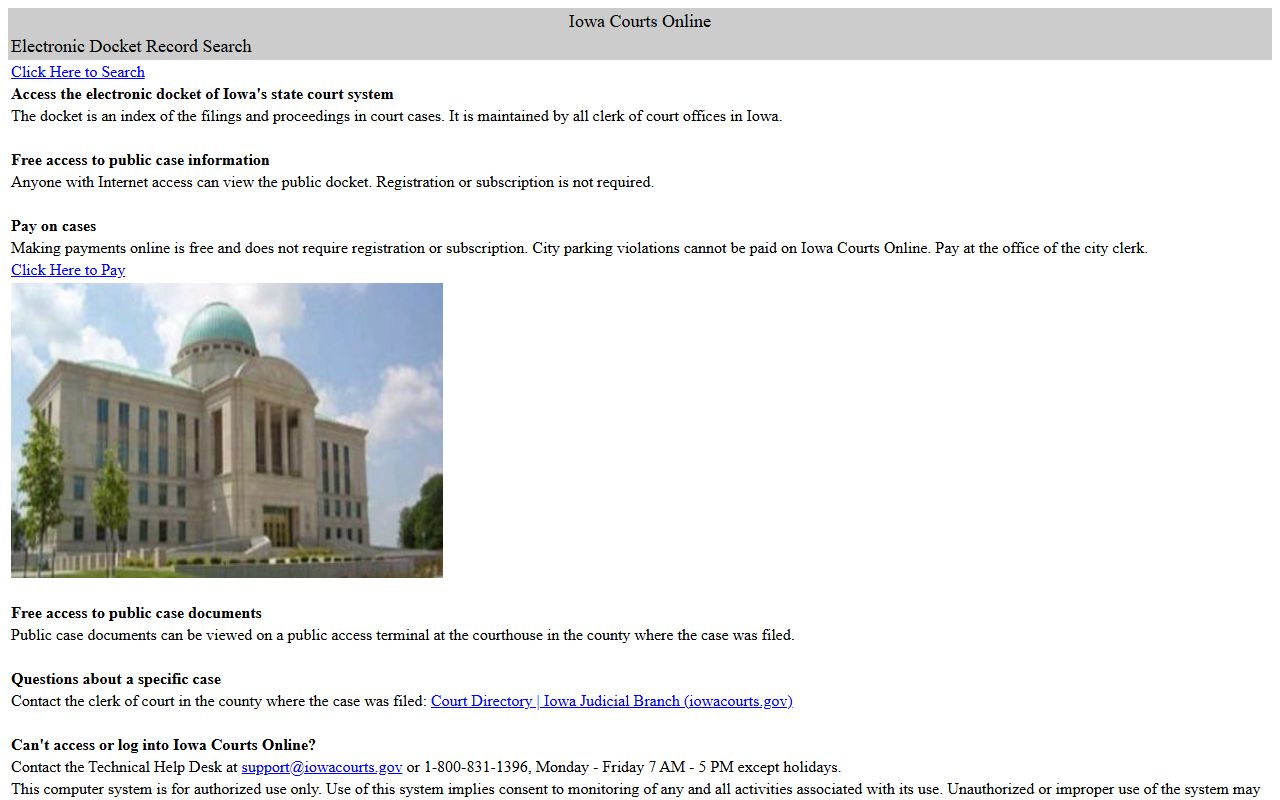
The portal is separate from the Fremont County jail because it tracks case filings and court events, not current cell status.
- Start with the sheriff press release or arrest log to capture the exact name, arrest date, charge wording, charge code, incident number, and any warrant reference.
- Open Iowa Courts Online and search by last name and first name. Narrow the county to Fremont and the case type to Criminal when common names return too many records.
- If the name search fails, use fewer letters, check for reversed first and last names, remove extra spaces, or search by citation number or case ID if one is available.
- Open the case ID and compare each filed charge with the arrest charge. Read the docket for pending events, dispositions, payments, and public filings.
- If the case is too recent, wait for clerk entry or contact the Fremont County Clerk of Court. Official help says a case entered into the case management system normally takes one business day to appear in search results, while citations may take up to 14 days.
Free public docket information can include case titles and filings, parties and lawyers, criminal charges, disposition entries, child-support payments, fines and fees owed, and payments. Some schedules, bonds, lien indexes, exhibit lists, service returns, and document links require a courthouse public terminal or paid subscription. Juvenile and confidential case records do not appear in the public search.
Fremont County Case Search Fields
Iowa Courts Online gives several ways to find court records after an arrest. Name search is the common starting point, but a case ID, citation number, or exact date of birth can be stronger when the spelling is uncertain. Official help says the last or firm name search needs at least two letters, date-of-birth search requires an exact date plus first and last name, and trial court case IDs use 17 characters. The number zero and letter O are not interchangeable.
| Field Label | Type | Required | Options / Format Notes |
|---|---|---|---|
| Last/Firm Name | Text | Yes for name search | Use at least two letters; fewer letters may help when spelling differs. |
| First Name | Text | Optional | Do not use a period after an initial. |
| Middle Name | Text | Optional | Can help separate similar names. |
| Alias Name Fields | Text | Optional | Useful for prior names or aliases. |
| County | Dropdown | Optional | Select Fremont County to narrow a statewide search. |
| Case Type | Dropdown | Optional | Choose Criminal for filed criminal charges. |
| Date of Birth Search | Date/text | Exact DOB required | Requires exact DOB plus first and last name. |
| Case ID Search | Text/dropdowns | County and case type required | Trial case ID has 17 characters; use capital letters. |
| Citation Number | Text | Citation required | Useful for traffic or simple misdemeanor matters. |
The wildcard percent sign can help find names that contain a string. Extra spaces, old cases, confidential cases, delayed citation entry, and name-scan errors can all cause a "no records found" result even when an arrest occurred.
Court Charges After Arrest
The formal charge record follows a charging document. A complaint can start a case from an officer or prosecutor's statement. An information is a prosecutor-filed formal charge used in many Iowa criminal cases. An indictment is a grand-jury charge and is less common in routine local cases. For Fremont County court records after a jail arrest, these documents matter because they are the bridge between the sheriff's accusation and the court's case file.
| Document | Who Uses It | What It Means for the Case |
|---|---|---|
| Complaint | Officer or prosecutor | Can begin a criminal case and support first appearance or warrant handling. |
| Information | Fremont County Attorney | Formal prosecutor-filed charge after review of the arrest and evidence. |
| Indictment | Grand jury | Formal charge by grand jury, more limited in routine county filings. |
The Fremont County Attorney's Office is led by County Attorney Peter Johnson at 506 Filmore Street, PO Box 476, Sidney, Iowa 51652. The office prosecutes violations of Iowa criminal law and county ordinances, handles juvenile and mental-health proceedings, and represents county government in official matters. It does not give private legal advice, represent private people, or prepare private legal documents. Defendants without counsel should follow court instructions before contacting the county attorney about a pending case.
The county attorney page is a useful source because it shows local case-number families. SRCR, AGCR, and FECR point to district criminal case types. STA, NTA, and SMMG can appear in traffic or simple misdemeanor matters. Case-number clues help route a question to the court rather than treating every issue as a jail-record question.
Fremont County Charge Status
Charge status explains where a count stands today. A charge can be pending after first appearance, amended by the prosecutor, reduced through plea talks, dismissed by court order or prosecutor action, or resolved by plea, verdict, deferred judgment, or another disposition. The sheriff press-release language may still remain online after the court record changes, so a current court search is the better source for case status.
| Status | What It Means | Where to Check |
|---|---|---|
| Pending | The filed charge has not reached final disposition. | Iowa Courts Online docket and clerk records. |
| Amended | The prosecutor or court changed the charge wording, count, or level. | Docket entries and filed charging documents. |
| Dismissed | The count or case was ended without a conviction on that charge. | Disposition entries and orders. |
| Deferred Judgment | Judgment may be deferred under court terms, with later expungement rules possible. | Court disposition and Iowa Code 907.9 issues. |
| Convicted | A plea or verdict resulted in a conviction on that count. | Disposition and sentencing entries. |
Public docket information is not legal advice. Court staff can explain records access and public terminal options, but they cannot tell a defendant what plea to enter, whether to waive rights, or how to defend the case.
Bond After Fremont Arrest
Bond and release details often appear in both sheriff publications and court records after a jail arrest. Fremont County press releases have used local examples such as cash bond, surety bond, cash/surety bond, and 10 percent bond after initial appearance. The sample arrest-log PDF also used release reasons such as SURETY BOND and CASH BOND. Those are local examples, not a guarantee that the same option applies to every charge.
- Cash bond
- Cash must be posted under the amount or terms set by court or warrant. Call Fremont County Jail at 712-374-2115 before attempting payment.
- Surety bond
- A surety or bond company backs the appearance bond. Confirm the bond type with both the jail and the court record.
- Personal recognizance
- Release is based on a written promise and court conditions rather than secured money when the court permits it.
- No-bond hold
- Release is not available until a judge or holding agency acts. Ask about out-of-county, probation, parole, federal, or immigration holds.
Iowa Code Chapter 811 governs bail in Iowa. The Iowa Judicial Branch uniform bond schedule gives baseline scheduled amounts for many offenses, but several charge categories require a judicial officer before bond can be set. In practice, the safe route is to verify the amount, type, and hold status through the jail and Iowa Courts Online before money changes hands.
Warrants After Fremont Arrest
No official Fremont County online active-warrant search was located in the research set. The sheriff's arrest-log materials do include a "Warrant #" field, and sheriff press releases mention warrant arrests, contempt, failure to appear, probation violations, and search warrants. A warrant reference may help locate the court case, but it can also be an agency key rather than a full case ID.
For public warrant status, use the sheriff office at 712-374-2424, the jail line at 712-374-2115, Iowa Courts Online, and the Fremont County Clerk of Court. If a person plans to surrender, the person should confirm where to appear, whether bond is set, and whether an attorney or court date is involved. Do not rely on an old press release to prove that a warrant is still active.
- Arrest warrant
- A court order authorizing arrest based on a complaint, affidavit, or probable cause.
- Bench warrant
- A warrant issued by a judge, often for failure to appear or failure to comply.
- Detainer or hold
- A request from another agency or jurisdiction that can affect release from jail.
- Disposition
- The current or final result of a court charge.
Charge Versus Conviction
Fremont County court records after an arrest must be read with the presumption of innocence in mind. The sheriff's arrest-log PDF and press releases warn that a criminal charge is an accusation and the defendant is presumed innocent unless proven guilty. A booking charge, filed charge, and conviction are three different points in the case. They may match, but they do not have to.
Charge: an alleged offense from law enforcement or prosecutor filing. It can appear in sheriff logs, complaints, informations, and docket charge lists, and it can be amended, reduced, added, or dismissed.
Conviction: a final finding from a plea, verdict, or qualifying court judgment. It appears in court disposition and sentencing records, and later appeal, expungement, or deferred-judgment rules may affect access.
Sealed and Expunged Records
Iowa public access rules do not make every arrest-related record visible forever. Iowa Code Chapter 22 gives public access to government records unless a statute makes the record confidential. Iowa Code 22.7 protects certain peace officer investigative reports, criminal identification files, juvenile matters, and other confidential records, while still treating current and prior arrests and criminal history data as public categories subject to exceptions. Iowa Code Chapter 901C and Iowa Code 907.9 address qualifying expungement and deferred-judgment expungement issues.
- Confidential case
- The public portal may not display the case. Juvenile and sealed matters require clerk guidance.
- Sealed record
- Public access is restricted by law or order, so search results may be limited or absent.
- Expunged record
- Qualifying records become confidential under Iowa expungement rules. Ask the court how the order affects public copies.
- Investigative exception
- Some law-enforcement material can be withheld while immediate arrest facts may remain public.
If a Fremont County case is dismissed, acquitted, deferred, or expunged, the court order controls more than an old arrest post. The clerk is the starting point for court record access, while the sheriff is the custodian for jail or arrest-record copies held by the sheriff.
Victim Notice and Case Updates
Victims and witnesses have a separate notification path. The Fremont County Victim Witness Assistance page explains that VINE can tell whether an offender is in jail and can notify registered users about release, transfer, or escape. VINE is useful for custody notice, but it is not the same as a certified court record, a sheriff records request, or a complete criminal-history report.
The Fremont County Attorney page also describes Victim Witness services such as court-notice help, explanations of the criminal justice process, financial-loss assistance, referrals, victim impact statement documentation, and safety concern routing. That office helps victims and witnesses understand process, but it is not a source of private legal advice for defendants or civil disputes.
Important: Court, jail, and partner search results are not consumer reports and may not be used for FCRA-covered decisions.